
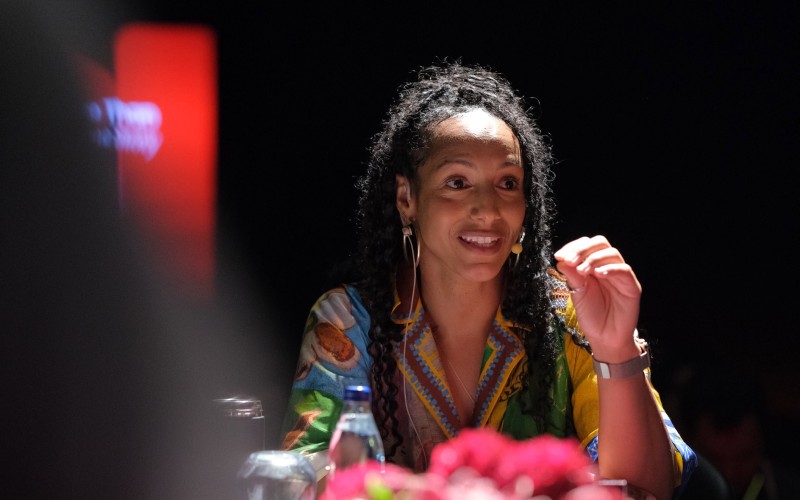
Afua Hirsch has built one of the most distinctive careers in British media. She is a writer, broadcaster, documentary maker, producer, academic and former barrister whose work connects race, identity, history, justice and culture. Her career has moved from courtrooms and international development to newspapers, television, books, podcasts and film production. This range has made her an influential voice in debates about Britain, Africa and the legacy of empire.
Born on 12 June 1981 in Stavanger, Norway, she is 45 years old in 2026. Her full name is Afua Caroline Owusu Hirsch, and she is British. Although born in Norway, she grew up in Wimbledon, south-west London, where her childhood shaped many questions she later explored in her writing. She has often described the contrast between London’s diversity and the mainly white, affluent part of Wimbledon where she was raised.
Afua Hirsch Early Life, Heritage and Family Background
Her family story brings together British, Ghanaian and Jewish history. Her mother is of Ghanaian heritage, while her paternal family includes a Jewish refugee who came to Britain after fleeing Nazi persecution in Europe. Growing up with a Ghanaian name and mixed-race identity gave her an early awareness of how race could shape the way other people saw her. She later turned those experiences into a wider study of belonging, class and national identity.
As a young person, she read thinkers such as Marcus Garvey, Malcolm X, Paul Gilroy and Stuart Hall. Their work helped her examine questions often missing from her school environment. She became especially interested in how African history was presented in Britain and why colonialism received limited attention in national debate. These interests became central to her later career.
Afua Hirsch Education and Oxford Years
Afua Hirsch attended Wimbledon High School before entering St Peter’s College at the University of Oxford in 1999. She studied Philosophy, Politics and Economics and graduated in 2002. Her thesis examined how the traditional role of women in Ghanaian society influenced politics after independence. Oxford deepened her interest in African politics, history and social change.
After university, she moved to Dakar, Senegal, and worked with the Open Society Institute in West Africa. Her work involved civil society, democracy, press freedom and human rights across West and Central Africa. She supported work connected with the press during conflict in Sierra Leone and Liberia and with greater transparency in oil and mineral industries. The experience later strengthened her journalism.
Afua Hirsch Legal Career Before Journalism
Afua Hirsch studied law at BPP Law School and qualified as a barrister at the Bar of England and Wales in 2006. At Doughty Street Chambers, her legal work covered housing, homelessness, immigration, asylum, disability, social care, criminal defence, press freedom and international justice. She also taught Constitutional and Administrative Law at BPP Professional Education. Law gave her a strong base in evidence, rights and public policy.
In 2008, she joined The Guardian as legal affairs correspondent. She covered debates involving counter-terror laws, civil liberties, privacy, the Iraq War and state power. Her legal training helped her explain difficult court and policy issues with clarity. Journalism became the main channel through which she examined justice and public life.
Afua Hirsch at The Guardian and in West Africa
In 2011, she became The Guardian’s West Africa correspondent and moved to Ghana. She helped establish the newspaper’s first West Africa bureau and covered politics, business, culture, technology, conflict and environmental harm. She also made a film about illegal Chinese gold mining in Ghana and its effects on forests, water and communities. Her work combined hard news with a wider view of modern African life.
Her years in Ghana strengthened the link between journalism and heritage. She also focused on creativity, entrepreneurship, food and cultural change rather than presenting Africa only through crisis. She has continued to write columns and long-form pieces for major publications, including Time, Vogue and The New York Times. Race, history and social justice remain central to her writing.
Afua Hirsch Sky News Career and Television Work
Afua Hirsch joined Sky News in 2014 as Social Affairs Editor and covered housing, education, inequality and family life. She later became a familiar face on current-affairs television and took part in Sky’s debate programme The Pledge. Her broadcast work also brought her to BBC Question Time, Newsnight and Channel 4 News. Television gave her another way to combine history, politics and personal experience.
Documentary work became a major part of her career. She presented The Battle for Britain’s Heroes and later worked on programmes exploring African art, empire and slavery. She co-presented Enslaved with Samuel L Jackson, an international series on the transatlantic slave trade. She has also made programmes dealing with African history and the relationship between art, memory and power.
Africa Rising with Afua Hirsch
Africa Rising with Afua Hirsch presents African societies through culture, creativity and self-definition. The series has taken her to Ethiopia, Senegal, Kenya, Nigeria, South Africa and Morocco. It explores music, art, fashion, film, dance, colonial history and younger creative generations. African voices remain at the centre of these stories.
Afua Hirsch Books and Writing Career
Her best-known book is Brit(ish): On Race, Identity and Belonging, published in 2018. The book blends memoir, history and social analysis to examine what it means to be Black and British in a country still shaped by empire. It became a Sunday Times bestseller and earned major critical attention. Hirsch also received the Royal Society of Literature’s Jerwood Prize while developing the work.
She later wrote Equal to Everything, a children’s book inspired by Lady Brenda Hale and equality before the law. Empire: Look Again encourages younger audiences to examine Britain’s imperial history with fresh eyes. Her 2023 book Decolonising My Body: A Radical Exploration of Rituals and Beauty turns to beauty, hair, body image and cultural practice. It connects personal experience with race, femininity and inherited beauty standards.
Afua Hirsch as a Contributor and Cultural Writer
Her writing extends beyond her own books. She has contributed to Can We All Be Feminists?, Goodbye Europe and Pretty Bitches. Her essays combine personal reflection with political and historical analysis. She also writes on fashion, culture, gender and the African diaspora.
Afua Hirsch Podcast Work and Legacy
Podcasting is another major part of her media career. She hosted We Need to Talk About the British Empire, an Audible series examining personal experiences connected to empire. She also co-hosts Legacy with historian Peter Frankopan. The programme studies famous figures and asks how reputations change when achievements, failures and moral choices are viewed together.
Legacy suits her interest in history and contested public memory. Instead of treating historic figures as simple heroes or villains, it examines how power and later generations shape reputation. The project has also developed into a business venture. In 2025, Hirsch became a director of Original Legacy Productions Ltd.
Afua Hirsch Husband Sam, Daughter and Private Life
Afua Hirsch’s husband and long-term partner is Sam. They met in their early twenties when both were pursuing legal careers. Sam is of Ghanaian heritage and grew up in Tottenham, north London, in circumstances different from Hirsch’s childhood in Wimbledon. She has used that contrast when writing about race, class and opportunity in Britain.
The couple have a daughter, born in 2011. Hirsch keeps much of her family life away from celebrity culture, and Sam maintains a low public presence. His surname, wedding date and current professional role are not central parts of her public career. Her family has nevertheless influenced her writing about belonging and British identity across generations.
Afua Hirsch Academic Career at USC
In 2018, Afua Hirsch joined the University of Southern California’s Annenberg School for Communication and Journalism in Los Angeles. She has held the Wallis Annenberg journalism chair and is now a Professor of Journalism. Her academic work reflects the subjects that shape her media career, including race, politics, social justice, history and culture. Her professional life connects London and Los Angeles.
Afua Hirsch Born In Me Productions and Business Career
Hirsch established Born In Me as an independent production company focused on scripted and unscripted television, film and podcasts. In 2021, Born In Me secured a global first-look partnership with Fremantle and De Maio Entertainment. The deal increased its ability to develop diverse projects for international audiences. Storytelling with cultural purpose remains at the heart of the company.
Born In Me Productions Limited was incorporated in 2020, while Born In Me Studios Limited became part of her company activity in 2026. She also became a director of Original Legacy Productions in 2025. Earlier directorships included The Death Penalty Project, The Human Dignity Trust and AFRUCA. These roles reflect her long interest in human rights and social justice.
Afua Hirsch, Fashion and Sika
Hirsch has also been involved with Sika, a fashion label producing African-inspired clothing in Ghana with an ethical production focus. She has worn pieces connected to the brand during broadcast appearances. Fashion became a deeper subject in Decolonising My Body, where hair, beauty, clothing and ritual become parts of identity rather than surface concerns. This interest fits naturally with her wider work.
Afua Hirsch Awards, Honours and Public Influence
Her career has brought recognition across law, journalism, literature and broadcasting. Honours include the Denning Prize from Lincoln’s Inn, a Black Magic Awards Inspiration Honour, the Campaign for Broadcasting Equality Journalist of the Year award and the Royal Society of Literature Jerwood Prize. She was also elected a Fellow of the Royal Society of Literature, giving her the letters FRSL. These honours reflect a career crossing many fields.
Her online audience is substantial. She uses social platforms to discuss books, documentaries, politics, culture and new projects, with more than 100,000 followers on both Instagram and X in 2026. Her public identity rests on more than fame. It is built on a long body of work about power, history, identity and justice.
Why Afua Hirsch Remains an Important British Voice
Afua Hirsch has spent more than two decades moving between law, journalism, books, television, education and production without losing the central purpose of her work. She examines who gets to define Britishness, how empire continues to influence modern life and why African cultures deserve to be presented in their full complexity. Her work asks audiences to reconsider familiar national stories.
In 2026, she remains active as an author, broadcaster, podcaster, producer and academic. From Brit(ish) and Decolonising My Body to Legacy, African documentaries and Born In Me, she has created a body of work centred on identity, dignity and historical truth. Her ability to combine serious study with accessible storytelling has helped her reach a wide audience. It has secured her place as one of Britain’s most distinctive cultural voices.
Also Read